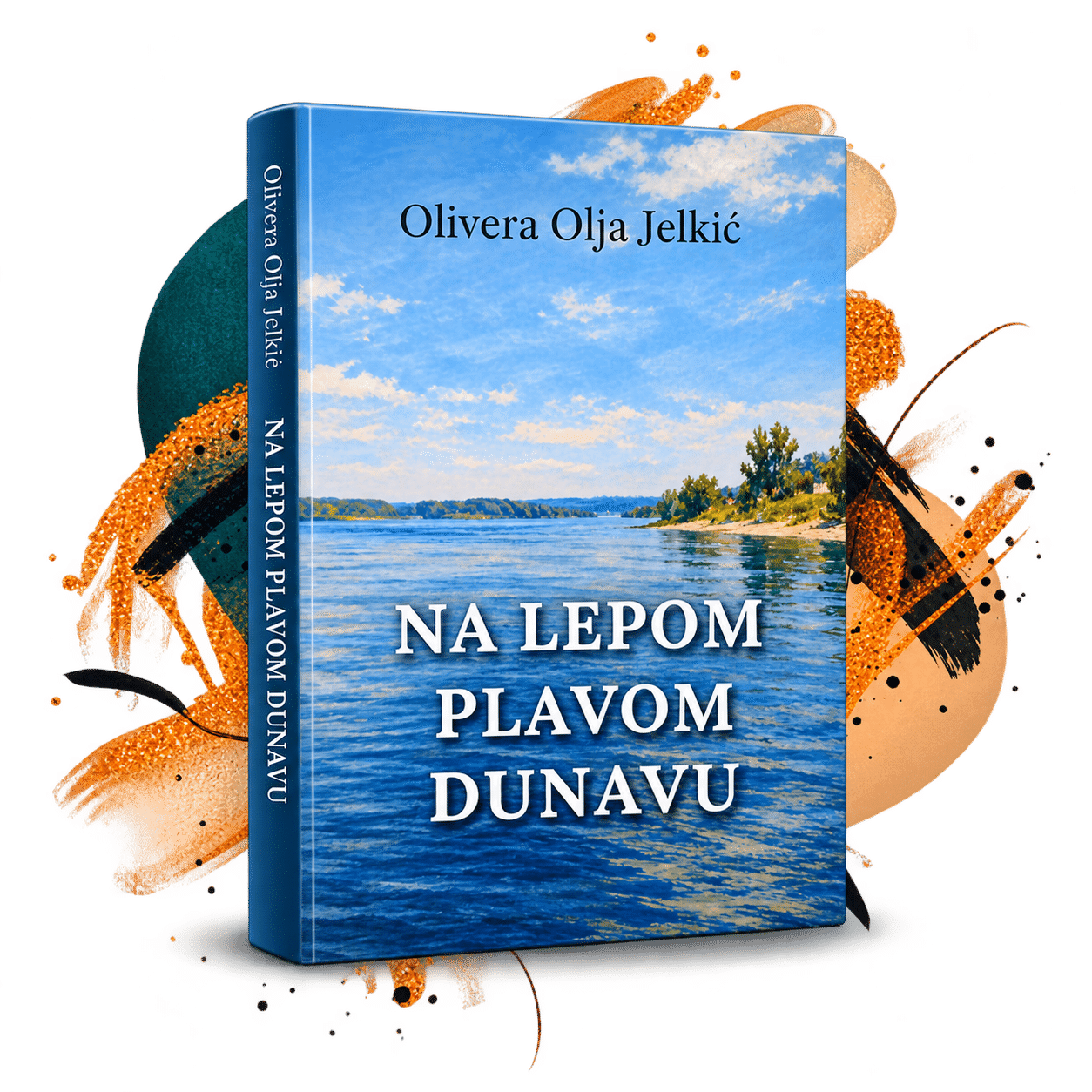










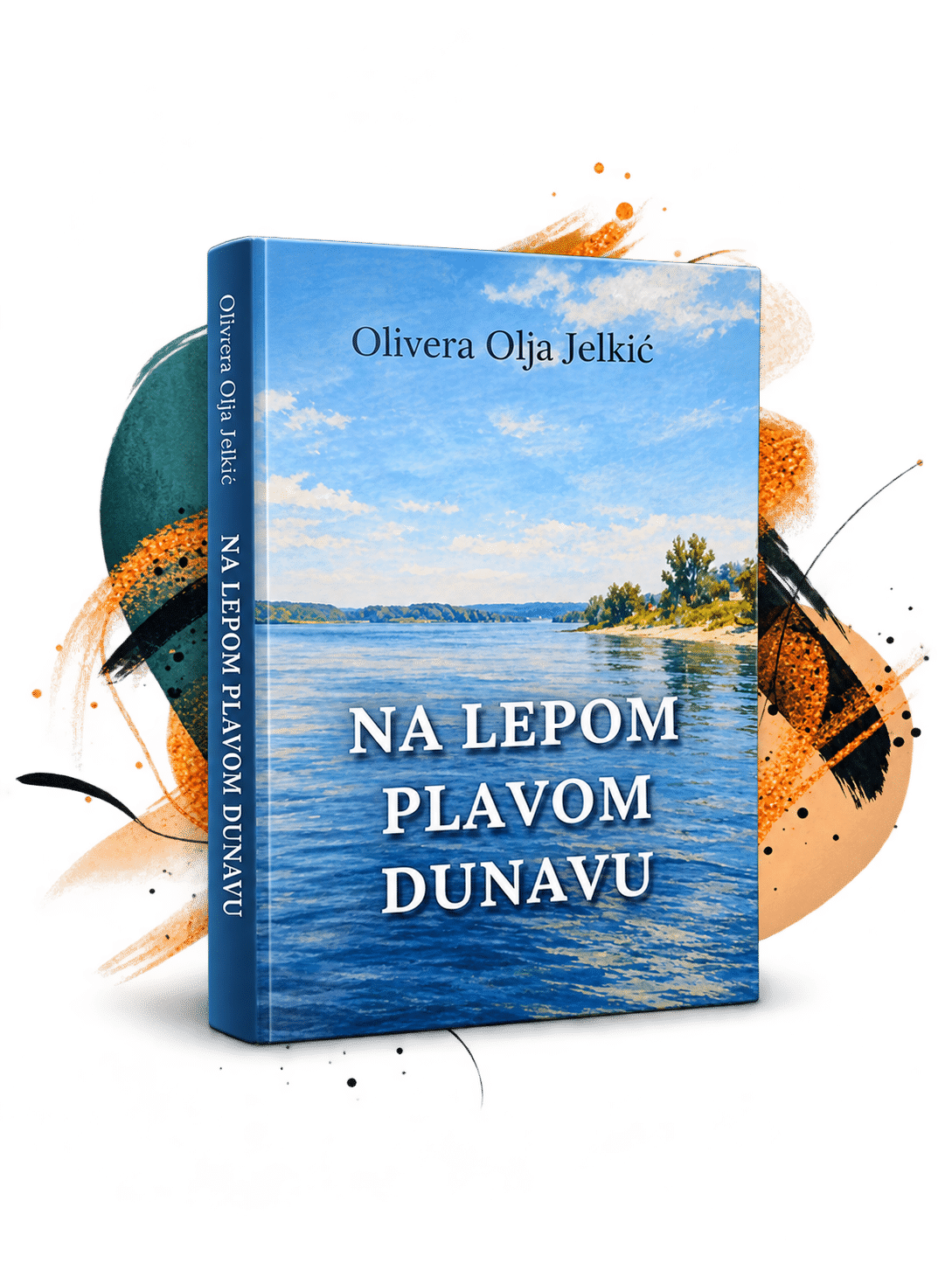
On the Beautiful Blue Danube
Following her successful and highly authentic novel about Ludwig van Beethoven, Ludvig (2018), Olivera Olja Jelkić continues to explore a similar and intriguing subject, this time focusing on the renowned composer Johann Strauss II.
This relatively short yet undeniably engaging and dynamic novel, which presents readers with the story of Johann Strauss II, his stay in Futog, and his encounters with the Danube, nature, and an extraordinary young woman, rests on a simple but highly rewarding literary premise: what happens when a man who has spent his entire life surrounded by music, fame, and social conventions finally steps outside his own cage and encounters freedom? The answer offered by the novel is neither simple nor entirely happy. Freedom reveals itself as a moment of enlightenment, but also as an experience capable of causing greater pain than any form of captivity.
The story is set against the historical backdrop of the second half of the nineteenth century, in the landscape of Futog, the Danube, and the aristocratic world of the Kotek family. The castle, park, stud farm, fishpond, horse-drawn carriages, steamboats, aristocratic receptions, and hunting parties create a recognisable historical setting, yet this setting is far more than a decorative background. It serves as the stage upon which two worlds meet: the world of privilege, education, music, and social prestige, and the world of the river, labour, simplicity, and immediate experience. Johann Strauss moves between these two worlds.
At the beginning of the novel, Johann arrives in Futog as a man who possesses almost everything an artist could wish for: fame, reputation, talent, and recognition. Yet he is troubled by something that remains almost entirely invisible to others: exhaustion and a creative crisis. His problem is not a lack of music, but an excess of obligations. He has become a prisoner of his own fame. Concerts, journeys, performances, and social commitments have gradually displaced the very reason he became an artist in the first place: the need to create. In this sense, the novel establishes an important paradox from the outset: a man who brings freedom to others through music is himself no longer free.
The Danube therefore assumes a significance far deeper than that of an ordinary landscape. It becomes a realm of freedom. Johann experiences it differently than before. The same Danube he knows from Vienna now becomes a new river, almost an entirely new world. Its vastness, river islands, sandbanks, willow groves, waters, fishermen, and unpredictable currents gradually become part of his inner experience. The Danube is no longer merely a geographical location; it becomes a mirror of the protagonist’s inner life.
Particularly impressive is the image of the Danube’s islands as “brooches upon the Danube.” This metaphor reveals the way Johann, as an artist, perceives the world. He does not merely observe nature; he attributes aesthetic value to it. What constitutes everyday life for a local inhabitant becomes a revelation for the artist. Here, the novel establishes one of its most compelling tensions: what is life itself to one person becomes inspiration to another.
However, Johann’s growing closeness to nature does not immediately signify a genuine closeness to life. On the contrary, when he sets out alone in a boat towards a river island, a dramatic reversal occurs. The Danube, until then a beautiful, romantic, almost pastoral setting, reveals another face. A countercurrent, the capsizing of the boat, and the struggle for survival shatter his illusion that nature can be mastered simply because a person is talented, educated, or famous. At that moment, Johann experiences his own vulnerability directly for the first time.
This scene is one of the novel’s pivotal moments. As he struggles for his life, his entire biography passes before him: his father, his mother, the violin, the bank, his brothers, his personal choices, and missed opportunities. His struggle against the Danube thus becomes a struggle with himself.
In the water, he symbolically confronts his own life. He realises that being a great artist is not enough to understand everything life may place before a human being. Equally significant is the moment when Johann recognises his own arrogance. He admits to himself that he has underestimated fishermen, coachmen, and day labourers, believing that whatever they could accomplish, the “maestro” could accomplish as well. Yet his experience on the river demonstrates precisely the opposite. What is an unfamiliar adventure to him is everyday life to them. In this way, the novel subtly introduces a social dimension. Knowledge is not limited to what is acquired through formal education; there is also the knowledge of life itself, an experience that cannot be found in books or measured by academic titles.
In this sense, Konstanca is perhaps the most important character in the novel. She represents a counterpoint to Johann. He is a man of palaces, concert halls, and European fame; she is a child of the Danube. He knows the orchestra; she knows the river. He commands music; she commands her own small world upon the water. It is no coincidence that Johann perceives Konstanca as a “Danube fairy.” To him, she is not merely a beautiful young woman whom he has encountered by chance. She becomes the personification of everything he lacks: freedom.
Their conversation about the “cage” represents the novel’s central philosophical idea. Konstanca expresses the thought that everyone lives in some kind of cage: some in golden cages, others in impoverished ones; some in cages of obligation, others within their homes or professions. The only difference is that some cages are visible, while others remain unseen.
This thought transcends the immediate circumstances of the characters and becomes a key to interpreting the entire novel. Johann is imprisoned by fame. Konstanca, outwardly at least, is confined by her life on a boat. Count Kotek is imprisoned by aristocratic duties and expectations. Even the animals in the novel form part of this symbolic system: beautifully cared for and protected, yet nevertheless confined. Thus, the novel is not merely about freedom, but about the human need to determine for oneself what freedom truly means.
Konstanca is therefore far more than a romantic heroine. She becomes a kind of teacher to the protagonist. She does not teach him music, for he has already mastered that art; she teaches him about life. Her spontaneity, directness, knowledge of the river, and fearlessness in the face of everyday existence reveal to him a world beyond his concert halls. Her statement that the Danube is “great and good” encapsulates her philosophy: nature should not be conquered, but understood and respected.
Interestingly, the novel does not develop its love story according to a conventional pattern. Johann and Konstanca meet, recognise something in one another, and experience mutual attraction, yet the social divide between them remains almost insurmountable. Their love is never realised in the conventional sense. It occurs as a brief, intense encounter before passing into memory and art. Precisely for this reason, it becomes more compelling in literary terms than a straightforward romance with a happy ending.
The decisive moment comes during their second encounter at the castle. Konstanca sees Johann and, recognising him as Schani, calls out his name. He cannot approach her, and she runs away. At that instant, everything that might have become reality turns into a lost possibility. Johann understands that his world, his name, and his social position carry a price. His fame, previously a burden, now becomes an obstacle between him and the woman he has come to love.
Here, the novel returns to its central motif: the cage. Johann is no longer merely a man imprisoned by his obligations. He is also imprisoned by his own name. Paradoxically, a man who wishes to remain unknown cannot escape his fame. Even those who serve him recognise him through his music. His name travels faster than he does. At precisely this point, music becomes the only possible realm of freedom.
The waltz born from his encounter with Konstanca is not merely another composition. It is the artistic transformation of a romantic experience. What Johann could not achieve in life, he achieves through music. Konstanca cannot become his, but her image can become music. The Danube cannot change his life, but it can become a melody. Unfulfilled love does not disappear; instead, it is transformed into a work of art.
This is why the final motif of the musical score is particularly powerful. Johann leaves Futog carrying both happiness and defeat within him. In a small inner pocket, he carries the score of a waltz dedicated to the Danube Fairy. Mačkov Sprud remains behind him, but everything that happened there travels with him to Vienna. The final image of the steamboat moving upstream, “just like life,” brings the novel to a close on a symbolic note. Life moves forward, but art preserves what life has been forced to lose.
One of the novel’s particular strengths lies in its atmosphere. With considerable attention to detail, the author reconstructs a world that no longer exists: aristocratic castles, horse-drawn carriages, steamboats, hunting parties, fishermen, river barges, traditional crafts, dishes, wines, local customs, and social relationships. This documentary dimension lends the novel an almost cinematic visual quality. Readers can readily imagine Futog, the castle, the Danube, Mačkov Sprud, a fisherman’s barge, and a drawing room with a piano.
At the same time, the novel possesses a pronounced sense of humour. This is especially evident in the conversations between Johann and the Count, but also in scenes involving Konstanca, whose direct manner of speaking stands in complete contrast to the polished language of aristocratic society. The episode involving the catfish, the dog Pici, Schani’s fall into the Danube, and his humiliating confrontation with his own clumsiness disrupt any tendency towards excessive sentimentality and bring vitality to the narrative. Humour is important here precisely because it makes serious themes — freedom, death, guilt, love, and art — more human.
The novel is, however, at its most compelling when it moves beyond a historical anecdote about a famous composer and transforms that anecdote into a story about the price of artistic talent. Johann is famous because he is gifted. Yet talent is not merely a privilege; it is also an obligation. An artist must continue creating even when his strength is exhausted, must bear the weight of his own name, and must live with the expectations of his audience and his own desire to surpass everything he has already accomplished.
His creative crisis thus acquires a deeper significance. He is not merely afraid that he will no longer be able to compose. He fears that he will cease to be who he truly is. When he says that he cannot spend his entire life performing old compositions and must return to his fundamental vocation of composing, he is actually expressing the human need to rediscover one’s own identity.
For this reason, the “waltz” of the title is not merely a musical form. It is a metaphor for life. A waltz revolves, returns, repeats, and follows its own rhythm and circular patterns. Johann moves through the novel in much the same way: from Vienna to Futog, from the castle to the Danube, from security to danger, from self-confidence to humility, and from encounter to separation. In the end, he returns to the place from which he came, but he is no longer the same man.
Waltz for the Danube Fairy thus becomes a metaphor for an unrealised possibility. It is the music of an encounter that lasted only a short time but left an impression capable of enduring far longer than the encounter itself. Konstanca remains on the Danube, Johann departs for Vienna, but music remains between them.
The novel’s conclusion consequently resembles a quiet elegy. Through the window of the steamboat, Johann searches one last time for Mačkov Sprud, the river barge, and the world that briefly became his own. When he catches sight of the dog Pici, he calls out its name almost as though he were calling for Konstanca. At that moment, he understands that his departure from Futog is not merely physical. He is leaving a part of himself behind. The musical score in his pocket represents the only proof that this world was not a dream.
Herein lies the deepest value of the story: art becomes the place where everything that life could not fulfil is granted a second existence.
The novel can therefore be read as a historical narrative, a love story, a story about an artist, a novel about the Danube, but also as a philosophical reflection on freedom. Its fundamental message is not that one kind of life is better than another. Konstanca does not desire Johann’s world, while Johann, if only briefly, begins to envy hers. Everyone has a cage of their own. The only question is whether they are capable of recognising its bars. And in Futog, Johann sees his own for the first time.
Thus, he returns from this brief stay with far more than a new composition. He returns with a new understanding of himself. The Danube has brought him not merely inspiration, but a mirror. In that mirror, he has seen the artist, the man, the lover, the son, fame and frailty, and, above all, a human being who has come to understand that some of life’s greatest stories do not end with two people sharing a life together, but with a single melody that preserves them forever from oblivion.
Dr Milutin Đuričković
Member of the European Academy of Sciences and Arts

The promotion
of the novel Ludvig
in Belgrade City Library
2018

The promotion
of the novel Ludvig
in Belgrade City Library
2018

The promotion
of the novel Ludvig
in Belgrade City Library
2018
Beethoven’s
Love Crossroads
(About the novel for young adults “Ludwig” by Olivera Olja Jelkićin”Čigoja” edition, Belgrade, 2018)
Besides his timeless music, Ludwig van Beethoven was also famous for having a lot of women in his life. The young composer, who, as a teenager, had to entertain the representatives of high society to earn for his family’s survival, which his alcoholic father couldn’t provide for, was, at that time (the end of the eighteenth century), one of the most talented pupils of the great composer Joseph Haydn. During one of the concerts in his hometown Bonn, he meets beautiful, eighteen-year-old Jeanette d’Hontarfrom Cologne, who is staying with her cousin Eleanor Browning at that time. Teenage love rages with insurmountable force. Two young teenagers fall in love with each other, thinking there isn’t a force that could separate them. Of course, a well-known Cologne family, especially the father of young and beautiful Jeanette does not want to hear a word about the anonymous pianist and as fast as he can, he marries off his too-young daughter to a significantly older captain Carl von Grete and she moves with him to the center of European culture – to Vienna.
Olivera Jelkić, as a wise and skilled authoress, creates one rather rigid love triangle, which finds its literary and historical refuge precisely in Serbia, in the planes of Syrmia where Ludwig pursues his only love, since the captain, having found out that he is a potential threat to his marriage, asks for a transfer to a remote Schloss. Unhappy and disappointed Jeanette unwillingly goes with her husband, but as the authoress develops the story, love always finds a way to happen. Namely, young and infatuated Jeanette succeeds in sending a letter to her beloved Ludwig to invite him at the time when her husband goes away for a long leave.
Olivera Jelkić leads this beautiful novel precisely along the stray paths of Syrmia area, and it’s on the road story with a magnificently composed narrative, and with an original idea. “Ludwig” does not impress only with a story about a young composer, which people didn’t know about so far, and it’s connected with the Serbian area, but it is also a story about the love story which knows no boundaries. Yearning for each other, Jeanette and Ludwig believe till the last moment that they will overcome all the imposed obstacles and that they will go together, like the authoress says “to the end of the world”. However, the point of the novel is completely different and it is precisely its deepest probe, and that’s the rationale which warns us that every overwhelming emotion and dedication becomes bitter destiny fatal for young people’s life when reflected in the mirror of real life.
The young Ludwig van Beethoven’s adventure throughout Syrmia area is also an intersection of the life of poor people involved in agriculture at that time, but here he is introduced to a civilization he has never dreamed of. As a talented, but frail young man, he comes into contact with the tougher side of lifein Syrmia, which provides him with the experience which he couldn’t get in the urban environment of Vienna. Precisely that dialogue of civilizations is one of the prettiest attributes of this completely original novel by Olivera Jelkić. The continuous comparisons of simplicity against cunningness, benevolence against subterfuge are the aspects which make this novel an anthology, with the eternal struggle of good and evil becoming the mechanism which fuels the whole plot in this entire love story. However, the narration process in the novel “Ludwig” is not subject to the black and white representation of destiny of the two main characters, but also of the characters that push them together. A gallery of characters that Ludwig meets are dynamic characters determined by social turmoil and their social status. In that way, by going on an uncertain adventure in order to get to his loved one, he experiences life events he has never had, and meets the characters he never thought to have existed at all. By getting into accidents, some of which were real dangers, this young artist becomes aware that life is not only music and high society community. Life philosophy he faces, by meeting people of various aspects and from different social status, diametrically changes his world view so that he is a completely different man when he is finally reunited with his great love. In the end, this is the greatest value of Olivera Jelkić’s novel. This exceptionally talented authoress does not write the novel solely to tell a story. She creates characters that are complex and clearly incorporated into the eclecticism of the entire content. As an experienced authoress, she is aware that an elementary love story does not correspond with philosophical premises and that it is subordinate to a simple sequence of events. Olivera Jelkić knows very well that she is describing the character of one of the greatest composers in the world and, by building this complex character, she doesn’tmove away from the criteria of his relation toward the world through a kaleidoscope of music, and so she succeeds in turning his entire suffering and effort he makes to get to his beloved into an inspiration which the great composer mostly relies on in the earliest period of his creation.
Besides the main character, the novel “Ludwig” also has a current which represents a pure love ecstasy and that is young and fragile Jeanette. The young girl, despite being married at an early age of eighteen has the greatest wish, and it is to spend her whole life with the one that her heart chooses, but, like Ludwig, she isn’t aware of the reality she loves and lives in. Living in a society where status matters most, she becomes the victim of her parents’ calculations and experiences tragedy, which she wants to escape from with all her efforts. Of course, the reality is both, happiness and unhappiness, and the young Jeanette very early discovers the complexity of life, as the wife of a captain with high social status. Actually, with these two characters, the authoress runs, through the entire novel, two ways in which the young people face the complexity of life, with the shattering of illusions, with life’s turmoils, so that “Ludwig” is also a novel about human reflection in the turbulent water of life, where the ideal is only distant yearning, and real life is a boring time flow, the escape from which is only suffering with no results.
Besides these characters, “Ludwig” also possesses a gallery of episodic characters, which have very strong personalities and are exceptionally shaped, the characters which mark a turbulent period, the end of the eighteenth century, when that part of Serbia was within the Austro-Hungarian Empire ruled by Joseph II. The characters that young Ludwig meets in his adventure through Syrmia are different and have different social backgrounds and various occupations, but that’s a conglomerate of the period with the ruthlessness, which we unfortunately also witness in this time period, which is technologically much more advanced. And, in that way, OliveraOljaJelkić’snovel “Ludwig”is universal, complex and quite inspirational. Besides a very specific and original love story, this exceptional novel also inspires with its marked relation to one period and a brilliantly managed dialogue of civilizations and this is what marks its uniqueness and layering.
No one would assume that there would be a novel in Serbian literature about the experience of the great Ludwig van Beethoven with Serbian civilization and the Serbian way of life. However, civilization is contradictory and very odd, so stories like this one always happen. OliveraJelkić’s novel “Ludwig”witnesses civilization intertwining and controversy, but is also a witness to love fluid and her philosophical creation.That’s the reason why “Ludwig” is a great treasure of Serbian literature, which should be jealously guarded and honored.